

Smart Direct Mail Scaling: What It Is, Benefits, and Strategies
Imagine you are launching a small postcard campaign to re-engage inactive customers. The result surprised you, and it should. According to ANA, direct mail marketing provides an average response rate of 9%. It outperforms many digital ads and platforms. Elated, you decided to scale the campaign to 10,000 recipients. But now you have an inconsistent template, inaccurate addresses and delays in printing. This is where smart direct mail scaling changes everything.
Businesses can send thousands of customized pieces with the same ease as sending one. With smart direct mail scaling, you won’t have to compromise on brand quality or compliance.
In this blog, we will break down what smart direct mail scaling is and what its benefits are. We will also share scalable direct mail solutions strategies that you can implement.
Key Takeaways
- Smart direct mail scaling allows businesses to send bulk personalized mail pieces. It ensures consistent quality, accuracy and brand alignment.
- Scaling your direct mail efforts expands geographic reach and targets new customers. It reinforces brand presence and trust over time.
- Automating Print & Mail workflows removes operational bottlenecks in direct mail scaling. It allows businesses to trigger, personalize and track campaigns in real-time.
What Does Smart Scaling in Direct Mail Mean?
It is the ability to expand mailing operations using automation. The technique also uses data-driven integration and analytics. You can send bulk personalized direct mail pieces through a centralized system.
Every step from data validation, personalization, to printing, tracking and reporting is automated. It helps maintain consistent quality, accurate delivery and brand alignment at any scale. You can transform a one-time marketing blast into an automated one. With this process, you have an always-on offline communication engine.

What Are the Benefits of Scaling Direct Mail Campaigns?
Increased Reach and Visibility
Scaling allows expanding the coverage and introducing the brand to new customers. It creates consistent visibility. The recipient starts recognizing the brand in their mailbox. Scaling up reinforces familiarity and trust over time.
Improved ROI
Printing and mailing cost decreases as the campaign volume increases. Bulk printing helps companies negotiate a better cost per piece rate with vendors. It reduces the setup and per-piece fees. Additionally, USPS provides volume-based postage discounts for high-volume senders.
Additionally, physical mail fosters trust. By scaling the operations, businesses generate an immediate response. They also strengthen long-term customer loyalty. It has a compounding effect that boosts ROI over time.
Competitive Differentiation
A well-executed multi-regional campaign showcases a level of marketing maturity. It shows the commitment that many competitors overlook. You send your customers high-quality direct mail in a sea of emails and digital ads. It immediately captures their attention. When scaled using the latest tools and technologies, it helps a brand stand out.
Additionally, customers tend to ignore digital ads. But, since customers can hold and read direct mail, it leaves a long-lasting impression. Scaling this experience helps maintain consistent touchpoints throughout the customer journey.
💡Also Read: Direct Mail Marketing: The Ultimate Guide
What Are the Challenges of Scaling Direct Mail in the Traditional Manner?
Manual Process Prone to Error
Traditional direct mail execution depends on a series of manual steps. Businesses have to build address lists and coordinate with printers. They also have to track shipments across multiple vendors. It might not be a hassle for a small campaign. But the process becomes unsustainable when you want to scale. Every manual handoff increases the possibility of costly mistakes. There can be typos in addresses, mismatched designs or outdated customer records.
Consider this: according to USPS, 4.3% of mail is not delivered due to address errors. Suppose your business sends 100,00 mail pieces. Then it is 4,300 wastage in print, postage and missed opportunities. When you multiply that across multiple campaigns, the financial impact can be staggering.
Inconsistent Branding Across Campaigns
Scaling direct mail using a manual method requires different teams and third-party vendors. They make it impossible to maintain a unified brand identity. Fonts, colours, and tone can vary from one batch to another. It leads to a fragmented brand experience.
Inability to Measure Performance
Traditional direct mail operates in the dark. Without the right tools, marketers have no visibility as to what will happen next. At scale, this blind spot becomes costly. Businesses investing money struggle to determine which message led to conversion. It is difficult to understand which regions perform better. They can't figure out the exact number of delivered mail.
Limited Flexibility
It lacks the flexibility marketers need to respond to trends or customers’ behaviour. Suppose designing, printing and mailing the pieces are complete. Later, you need to make changes according to real-time trends. It can be time-consuming and expensive. It can result in weeks of delay, reprinting costs and wasted materials. Businesses lose the opportunities to engage the audience with relevant and timely offers.
💡Also Read: Direct Mail API – Send Letters, Postcards & Checks
Key Direct Mail Scaling Strategies
Use Data for Personalization
Use customer data to create a message that speaks to the recipient’s interest or behaviour. Connect your CRM or ecommerce platform with the automation solution. It will allow you to insert variable data into templates. By incorporating direct mail personalization at scale, you create a one-on-one experience. It builds loyalty and drives higher conversions.
Integrate With Digital Channels
A smart scaling strategy ensures that your offline communication syncs with online touchpoints. It ensures a seamless omnichannel experience. Suppose you connect your CRM tool with an automation solution. You can orchestrate campaigns across channels with a consistent message, design and templates. Take, for instance, a lead abandons their online cart. You can mail them a personalized postcard within 24 hours to remind them of the item left behind.
Optimize Campaign With Analytics
Use analytics tools and tracking mechanisms to track delivery status and engagement metrics. They also allow tracking ROI in real-time. You can incorporate QR codes, PURLs and unique promo codes into each mail piece. It bridges the gap and turns physical mail into a measurable, data-rich channel.
The QR codes and PURL link mailer to a personalized landing page or form. When recipients scan or visit these links, marketers can track several aspects. They can know the location, device type and format which led to engagement in real-time. Marketers can attribute sales, sign-ups and appointments to a campaign or audience segment.
Maintain Data Hygiene and Compliance
The quality of customers’ data, such as addresses, is the backbone of a marketing campaign. Poor address hygiene can derail even the most sophisticated direct mail campaigns. It can lead to undeliverable mail, wasted print and postage costs.
If the mail lands at the wrong doorstep and someone intercepts it, it leads to a compliance violation. You will be subject to a penalty. Smart direct mail scaling puts address quality and compliance automation at the forefront. Make sure your system automatically validates, cleanses and formats addresses.
We recommend using a third-party technology provider that is CASS-certified. It ensures your data is standardized and up-to-date as per national postal records. It assures its deliverability. Additionally, ensure that the platform encrypts the sensitive data. You must also enquire about enforcing role-based access control. They should guarantee that there will be no mishandling during printing or distribution.
Standardize Templates and Assets
Create a centralized asset library. It should have approved templates, logos, fonts, etc. The library minimizes the need to create a design for every campaign. When making a campaign, the marketing team can localize the message. They can ensure the overall design, layout, and compliance-approved content remains the same. The approach saves significant time. Additionally, businesses can launch their campaigns faster.
Moreover, it reinforces brand recall. The consistent design will allow them to recognize the brand immediately.
💡Also Read: Direct Mail Types For Your Marketing Campaign
Common Mistakes Businesses Make When Scaling Direct Mail, and How to Avoid Them
Overlooking Timing
Businesses tend to overlook timing when scaling campaigns. Additionally, the volume can lead to delays in production, approval and shipping. Suppose. You don't have an in-built buffer for unforeseeable delays. In this case, campaigns tied to specific events may miss their window. The mailer arrives after the event has passed. Businesses get no engagement, despite investing time and money into creating the campaign. We recommend making a lead time for each step of the process. It can be creative approval, printing, packaging or shipping.
Additionally, you must factor in postal and delivery times, especially during peak seasons. This is because at this time, shipping volume increases and delays are common. Moreover, you must coordinate with the sales and marketing team. You must ensure that each part of the campaign stays on track.
Skipping Testing
In a rush to scale, businesses often forget testing variations in direct mailers. Without data-backed experimentation, you risk sending an ineffective message to a large audience. It leads to a lower response rate and higher per-acquisition costs. We recommend testing small batches before committing to smart direct mail scaling.
Suppose you are a retail brand planning to launch a large-scale campaign for the new summer line. You plan to send 200,000 postcards. A smart direct mail scaling strategy would be to test two variations on a batch of 5,000 customers. For instance, you can send one set of mailers with a bold design and a large product image. It can have a 15% discount and a QR code linked to the online store.
On the other hand, the second set of mailers has a lifestyle photo. It can include a 20% in-store discount only and a PURL that shows the nearest retail store to the customers. Track both of them for specific days and use the insights to refine and scale your campaign. It ensures you don’t spend hours and money on an underperforming campaign.
Printing in Bulk Without Demand Forecasting
Bulk printing can be an effective and smart direct mail scaling strategy. However, it needs accurate demand forecasting to guide it. Businesses assume that bulk printing will lead to savings. But it is not possible without precise forecasting. They risk a misalignment between production volume and actual campaign demand.
Overestimating can lead to overproduction. On the other hand, underestimation can result in a shortage. It delays time-sensitive mailings. You must consider the potential for changes in design, messaging, and pricing. If you fail to do so, and as the elements shift, you will have a pile of pre-printed material that is useless.
You must also use predictive analytics from CRM and past campaign insights. It will help you estimate realistic distribution volume per segment or region. Dive into the historical campaign data. It helps identify seasonal trends, response rates, conversion rates and regional demand fluctuations.
Failing to Prioritise Customer Segmentation
Sending a one-size-fits-all message to diverse customers reduces relevance. It also limits the effectiveness of the campaign. As you scale the campaign, the impact can be prominent, leading to campaign failure and loss of money. Group customers based on variables like purchase history, geographic location and engagement level. Adjust your content based on the segment to improve response rate and ROI.
💡Also Read: Direct Mail Lists with Address, Name
How to Measure ROI for Scaled Direct Mail Campaigns?
Calculate the Direct Cost of Your Campaign
Factor in the printing, postage, fulfilment, design, and creative costs into your ROI. Use the following formula to measure how much money your smart direct mail scaling is making.
(Revenue – Cost) / Revenue
Compare Response Rate to Conversion Rate
After tracking the responses from QR codes, PURLs and special promo codes, you must link them to the sales. Analyze the website traffic, online stores and in-store visits triggered by the campaign. In case of PURLs and QR codes, you can use tools like Google Analytics. It can track conversions linked to the campaign landing pages. The tool will connect the action generated to results and revenue generation. You will get a clear picture of how well the scaled direct mail efforts are contributing to the bottom line.
Assess Lifetime Value Impact
The immediate ROI may not show the long-term benefits of new and re-engaged customers. To get a full picture, you must calculate the lifetime value. It helps predict the money the customers will spend in their entire journey with the brand.
💡Also Read: Direct Mail Automation Software
Automate Direct Mail Scaling With PostGrid’s Robust Offline Communication Technology
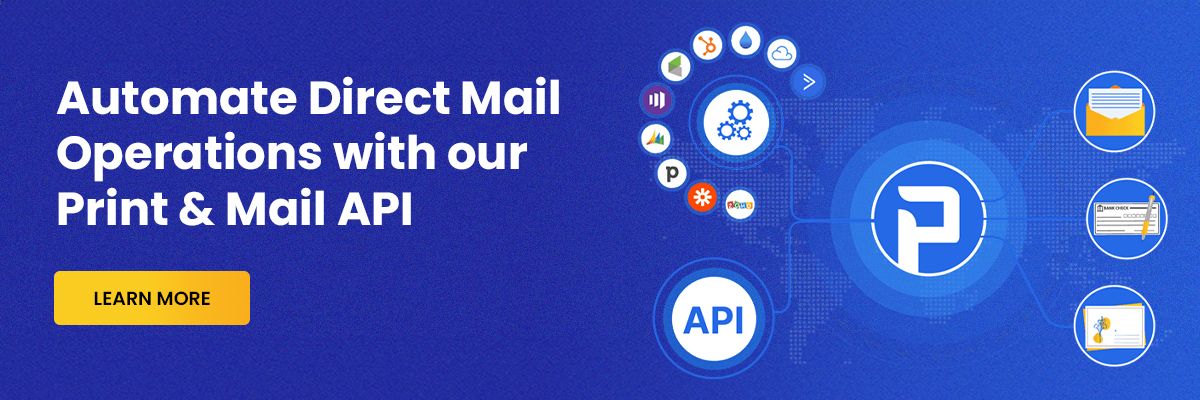
To achieve true smart direct mail scaling, your business needs to embrace automation. With PostGrid’s industry-leading technology, you can send impactful personalized direct mail at scale. We offer print and mail automation and real-time address verification technology. With us, you can rest assured that your direct mail campaign will scale without a hiccup.
We are a global leader in offering enterprise-level infrastructure for offline communication. Additionally, we guarantee precision and measurability just like digital channels. Unlock the power of smart, automated direct mail scaling with us by requesting a demo today.
💡Also Read:Send Direct Mail Natively from Ynfinite