


Sample Letter to Patients to Notify About Test Results
Using an automated system, healthcare organizations like hospitals and labs can accurately share test results with patients. However, before doing this, you should ask patients how they prefer to receive their results. Some might choose postal mail, while others may prefer email or phone.
When informing patients of test results by letter, you can reassure them with a comforting sentence. Let them know that you are there to support them and guide them regarding the further steps.
The patient can better understand their results if given the right resources. This allows them to evaluate their health. Therefore, healthcare organizations should include pamphlets and links to online resources in their mailings.
This blog discusses how to write a letter to patients to notify them about their test results with samples. Keep reading!
TL;DR
- Healthcare organizations should ask patients how they prefer to receive test results before conducting tests.
- Use compassionate language and avoid medical jargon to ease patient anxiety.
- Automated direct mail systems simplify notifying patients about test results.
- Ensuring HIPAA compliance is critical to protect patient information when sending communications.
Key Takeaways:
- Ask the patient how they prefer to receive their test results. Sharing test results with patients can sometimes cause anxiety. Therefore, always consider their mental state and use compassionate language when writing the letter.
- The letter notifying patients of their test results should answer their questions, not create more. So, use simple words instead of medical terms whenever possible.
- Healthcare systems often find it harder than expected to notify patients of test results. Using a fully automated direct mail system makes it much easier to inform patients.

Tips for Notifying Patients of Test Results
Most healthcare organizations, including hospitals and clinics, only communicate negative test results. When it comes to positive test results, patient notification of test results is usually carried out directly by the provider. Here are some tips for writing a letter to your patients informing them of test results.
1. Ask for the Patient's Preferred Communication Channel
The first thing you need to do before notifying patients of test results is to ask for their preferred communication channel. Some patients may choose to get their test results via postal mail, and some might pick email or phone.
Usually, healthcare organizations get this information from the patient before the test. It is also worth remembering that an in-person consultation is ideal if or when the result is upsetting for the patient.
2. Consider the Mental State of the Patient
As the healthcare service provider, it is up to you to access your patient's medical history and check on their mental state. For instance, if a patient has some form of anxiety disorder, it would do you good to know about it beforehand. Communicating test results to patients could be enough to trigger anxiety in some patients.
Another interesting point you should know is that more than 40 million adults in the U.S. suffer from an anxiety disorder, according to a study by ScienceDirect. Hence, understanding the patient's mental state will help you take a more gentle approach to them. In some cases, it may also warrant an in-person consultation.
Here’s an illustrative example: A family doctor’s clinic sent a letter after checking the patient’s blood test results from a regular checkup. The letter said the patient’s cholesterol was higher than it should be and needed to be looked at. It explained that this was not an emergency, but if it was not treated, it could raise the risk of heart disease over time.
The letter told the patient to make an appointment within two weeks to talk about what to do next. This could include changing their diet and possibly taking medicine. It also said another blood test might be needed to make sure the result was correct.
The letter included contact details for booking the appointment and a short explanation of what cholesterol does in the body and how it affects heart health. The message was calm and clear, helping the patient understand the problem without making them panic.
3. Make Sure the Patient Feels Comfortable
Ensure that your healthcare organization does everything it can to make the patients comfortable when they receive the test results. For example, if the patient is receiving the effect in person, you can offer them a glass of water and ensure they are in a relaxed environment.
When you use a letter to inform patients of test results, you can put the patients at ease by using a reassuring sentence. Let the customer know that there is nothing to worry about, even if the result is not looking good.
4. Be Extra Clear in Your Communication
When communicating test results to patients, the last thing you want is to confuse them. Medical terms are often, if not always, alien to your regular job. And that's just the beginning. The more medical terms and jargon you use, the more incomprehensible your letter will be.
The patient notification letter for test results is supposed to alleviate the patient's questions and not create more of them. Hence, you must use simple terms instead of medical terms whenever you can use them. Finally, let the patient know that they can reach out to you in case of any questions.
Here’s another illustrative example: A medical imaging clinic sent a letter to a patient after her regular breast X-ray (mammogram). The letter said that the doctor who looked at the pictures did not see any signs of cancer or unusual tissue. It explained that everything looked normal, so no more tests were needed right now. The letter also encouraged the patient to keep getting yearly mammograms as advised for her age.
The letter reminded her that a normal result does not mean there is no chance of problems in the future and gave some simple tips for taking care of breast health. It included a phone number for a nurse at the clinic in case the patient had questions or wanted to talk about the results. This type of letter helped calm the patient while still giving useful health information and keeping proper medical records.
5. Provide Necessary Resources
The patient notification of test results contains a lot of information, and the patient may not be able to grab everything in it. Understandably, the patient may need some time to process all the information before them.
The patient can learn more about their results by providing all the necessary resources. In other words, it gives them a chance to assess their health. Hence, healthcare organizations must consider including pamphlets and even links to online resources in their mailer.
6. Be Empathetic in Your Communication
When communicating test results to patients, try to be as empathetic as possible, especially if you are delivering bad news. Try to console them and offer a helping hand to your patients. And, if you are providing good information, then show that you are happy for them. Although it may not sound like much, such small actions or words can enhance the patient's trust in your organization.
7. Ensure Everything is Documented
As a healthcare service provider, you already know how crucial documentation is in the healthcare industry. It is safer to physically document your interactions on paper when informing patients about their test results. In the long run, it will help you avoid any potential confusion that could affect the reliability of your healthcare organization.
8. Maintain HIPAA Compliance
You must ensure you send your test result notifications to patients while keeping their Protected Health Information (PHI) private and secure. It is crucial to adhere to the HIPAA rules when printing and sending these letters. Also, you must ensure that the printer you select to produce the letters and the courier company mailing them also comply with HIPAA. It helps prevent unauthorized access to sensitive patient information and data leaks.
Luckily, PostGrid’s Print & Mail solution allows you to design, print, and ship letters to patients notifying them of test results under HIPAA compliance. Hence, you can rest assured that your patient data is kept confidential while you conduct the mailings. Sign up now for more details on our HIPAA-compliant letter printing and shipping solution!

Sample Letter to Patient About Lab Results
Many healthcare systems sometimes find notifying patients of test results more complicated than expected. It usually happens when the healthcare organization uses a manual or semi-automated direct mail process.
Using a fully automated direct mail system, informing patients of test results becomes a lot easier. The letter template is the only part of the automated postal mail process where healthcare organizations might have trouble. Given below are examples of patient notification for test results.
Please note: Both the samples below are for educational purposes only and must be reviewed by the clinical compliance/leadership team before use.
#1 Sample Letter Conveying Normal Findings
Dear [Patient Name],
I am writing you this letter to inform you of the results of the recent tests performed by [laboratory name] for [medical center name]. I am glad to inform you that the screening tests for [medical conditions] are NEGATIVE. The test results indicate no signs of infection from [medical conditions].
Considering your negative test results and the medical procedures you underwent during your time at our facility over three months ago, you do not require follow-up testing. However, I advise that you discuss the results with your physician and get all your health questions cleared.
The test results are attached to this letter. Please go through all the attachments with this letter. I am aware that there are a lot of medical terms in the results, and I am more than happy to explain everything to you.
If you have any further questions regarding your test, you can always reach out to us by calling [medical center name ]'s patient care line [phone number]. Our staff is available Monday through Friday between 7 a.m and 7 p.m.
Sincerely,
[Your Signature]
#2 Letter Conveying Abnormal Findings/Urgent Issues
Dear [Patient Name],
We are writing to inform you that we have received your diagnostic test results. The results are mostly positive, but there are some abnormalities. Your fasting blood glucose and cortisol levels are too high and need immediate medical attention.
Considering these results, we suggest you book an appointment with our on-call physician as soon as possible. His name is Dr. Mathew Louis, and he is available on all Mondays, Thursdays, and Fridays from 10 a.m. to 6 p.m. Please let us know if you would like to book an appointment by writing back to us at our address.
You can also visit our online portal to check availability and book a slot on any of your preferred dates. Also, you can write to us at [email protected].
You can also visit our online portal to check availability and book a slot on any of your preferred dates. Your credentials are your first and last name (username) and the date of your first visit with us (password). Also, you can write to us at [email protected].
We have attached the test results to this letter. Please feel free to contact us if you want to clarify anything or need any additional information. Thank you.
Yours sincerely,
[Name]
[Designation]
Frequent Mistakes When Writing Test Result Notification Letters and How to Avoid Them
Tone
A common mistake is using a tone that feels cold, rushed, or overly serious. It can make patients feel anxious, even if the results are normal. To avoid this, keep the tone friendly and reassuring. Write as if you speak to someone you care about, using calm and respectful words.
Language
Sometimes, letters use complicated medical terms that many patients don’t understand. This can lead to confusion or fear. It’s better to use simple, clear words that anyone can follow. If you need to mention a medical term, explain it briefly. The goal is to help patients feel informed, not overwhelmed.
Timing
One of the biggest mistakes is taking too long to send test results. Patients often feel nervous while waiting, and delays can increase stress. Send the letter as soon as the results are available to prevent such situations. If there’s a delay, let the patient know because quick communication helps patients feel cared for and respected.
 Also Read: How to Write an Attention Letter?

How to Use Direct Mail Automation for Notifying Patients of Test Results
Direct mail automation is an effective way to optimize your healthcare organization's patient notification of test results. Healthcare organizations would have to spend hours and hours sending patient notifications if they didn't use an automated system.
With a fully automated direct mail solution, you need a template or sample letter to patients about lab results. You can then set up the direct mail system to take care of the rest. PostGrid allows you to automate your patient notifications hassle-free.
In fact, just a couple of months ago, we helped our clients here at PostGrid, a leading healthcare provider, with their HIPAA-compliant direct mail communication. Using PostGrid’s advanced direct mail tool, we ensured the client could conveniently send HIPAA-compliant mail items, lab reports, invoices, and suggested treatment options.
Since PostGrid offers a fully automated direct mail system, one of our clients was able to minimize downtime in patient responses by 60%. It also meant that the client could save hours on manual mail processing. And we were able to do all this while ensuring all the mailers were personalized for each patient.
Here is how you can send messages to patients using PostGrid's advanced direct mail automation tool.
Step 1: Sign Up on PostGrid
The first step you need to take for automating patient notification of test results is to sign up on PostGrid's website. PostGrid’s signup process is relatively simple, where you provide your basic details such as your name, your organization's name, etc. You can set up your account in just two minutes.
Step 2: Log in to Your PostGrid Account
After signing up, you would have to confirm your email address. Once you do that, you can sign in to your PostGrid account.
Step 3: Create a Letter
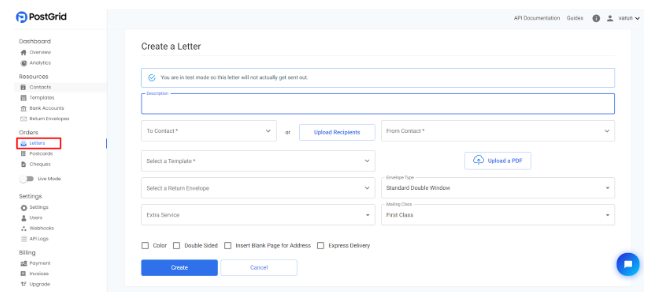
Once you log in, you will have the PostGrid dashboard in front of you. You need to select the option “Letters” from the “Orders” section of the dashboard. When you choose the “Letters” section on the dashboard, you will reach the section where you can set up your patient notification of test results letter.
Step 4: Set Up Your Patient Notification Letter
Once you navigate to the “Letters” section, you will arrive at the screen you see above. Here you can set up all aspects of your letter, including:
- Description
- Recipients
- Letter Template
- Envelope Type
- Mailing Class
- Return Envelope
- Extra Service
This step is crucial in setting up automated patient notifications of test results. Here, you can set every aspect of your patient notification letter, including the template design. You can either create a template using PostGrid or use one you have.
PostGrid even lets you choose the type of envelope and the best postal service suited for your postal mail communication. After you are satisfied with your mailer, you can mail your patient notification letter.
Benefits of Integrating PostGrid's Direct Mail System for Healthcare Communication
Integrating PostGrid's direct mail system for your healthcare communication has numerous benefits. PostGrid ensures that informing patients of test results is effortless. But that is just the tip of the iceberg. The other benefits healthcare organizations can get from PostGrid's advanced direct mail automation system are as follows:
- Create measurable direct mail campaigns for your healthcare organization
- Effortlessly personalize your mailers by integrating PostGrid with your CRM
- Optimize the deliverability of your postal mailers
Apart from the advantages listed above, there are several applicational benefits for healthcare organizations, such as:
- Patient statement printing and mailing
- Letter template management
- Workflow tracking and reporting
- Electronic bill presentation and payment
Workflow Example:
A medical lab finishes a patient’s blood test and puts the results into the clinic’s computer system. The doctor or healthcare provider looks over the results and approves a letter to be sent to the patient. Instead of clinic workers printing the letter, putting it in an envelope, and going to the post office, the clinic’s system sends the letter automatically through PostGrid.
The approved letter is safely sent to PostGrid, which takes care of printing it, putting it in an envelope, checking the address, and mailing it. The system keeps a record of each step, so the clinic can see when the letter was sent and track its delivery for the records and rules they must follow. If the patient needs follow-up care, another letter can be sent automatically or changed easily without extra staff work.
This process saves time for clinic staff, lowers the chance of mistakes, and helps patients get their letters faster and in a professional way. By using an automated system from the lab to the doctor to the patient, clinics can send the same type of clear, secure messages while protecting private health information and handling more patients without adding more work.
Also Read: How to Write Patient Dismissal Letter?Ensuring HIPAA Compliance With Your Healthcare Communication
HIPAA, or the Health Insurance Portability and Accountability Act, is something healthcare organizations cannot ignore, especially for direct mail communications. If you do not use a HIPAA-compliant solution like PostGrid for communicating test results to patients, you could end up paying hefty fines.
Hence, healthcare organizations must always make it a point to ensure that their communication channels are HIPAA compliant. HIPAA compliance is not a minor topic that we can brush through. However, you can learn more about HIPAA compliance here, where we discuss HIPAA in detail.
Conclusion
One of the complex challenges of communicating test results to patients is using the postal mail channel. Healthcare organizations are not equipped to handle direct mail communication with their patients. It only becomes more complicated when sending sensitive information such as lab results.
Furthermore, you have to consider several factors when writing a letter for patient notification of test results. However, by employing fully automated Direct Mail software such as PostGrid, you can easily bypass the challenges involved in postal mail communication.
You need to have a template for your patient notification letter. Using PostGrid's advanced tool, healthcare organizations can conveniently automate the entire direct mail process. Furthermore, the capabilities of PostGrid are not just limited to sending patient notification letters.
PostGrid lets you automate and optimize every aspect of your direct mail communication. As a result, you can send everything from patient billing statements to test result notifications to your patients. Request a demo to learn more about how PostGrid allows you to send notification letters to patients at scale!
💡Also Read: Service Outage Notification
FAQs
What is a Sample Letter to Patients to Notify About Test Results?
It is a written example that doctors and clinics can use to share medical results with their patients professionally. Thus, they can ensure that they have a standard format that they can tweak and send to all patients to keep them informed. The letter also helps patients learn about their results by explaining them in simple, easy-to-understand words.
What Information Should Be Included in a Test Result Letter?
A notification letter to patients to inform them about test results should have the patient’s name, the kind of test they took, and a short result summary. It should explain what the result means in plain, easy words. Also, it should inform the patient of what to do next. The letter can also include a phone number or contact details in case the patient has questions.
When Should Patients Receive a Test Result Notification Letter?
Patients should get their test result letters as soon as the results are ready and checked by a doctor or healthcare provider. Getting the information quickly helps avoid delays in care and can make patients feel less worried. Sending results right away is especially crucial when something is not normal or when the results need fast follow-up or treatment.