

Automotive Direct Mail Marketing to Maximize Sales
The automotive industry in the U.S. is highly competitive. Companies are constantly looking for unique ways to acquire new customers. One such underutilized marketing strategy is automotive direct mail. Most automotive companies overlook this medium because they consider it time-consuming, expensive, and slow.
However, direct mail has been revolutionized by automation. Now, businesses can easily send thousands of physical mailers with a single click. Automotive dealerships can easily track postcards and letters in real-time. Additionally, you can combine offline campaigns with digital marketing channels to boost awareness and track conversions. To help you build a successful automotive marketing campaign, this blog covers best practices, marketing strategies, and common mistakes to avoid.
TL;DR
- Automotive direct mail campaigns can boost awareness and cut through digital clutter.
- Businesses can promote seasonal car sales, new models, and core services via direct mail.
- Direct mailers offer instant visibility and have a longer shelf life than emails or SMS.
- Common mistakes include crafting generic mailers and using an outdated mailing address list.
Key Takeaways
- Automotive direct mailers are used to promote seasonal events, trade shows, and special launches.
- Direct mail is an underutilized marketing strategy that can yield high response rates and boost engagement.
- Studies have shown that people trust direct mail ads and recall them better than digital ads.
- By adding QR codes and PURLs, automotive direct mail pieces can be linked to digital marketing initiatives.
What Is Automotive Direct Mail and How Does It Work?
Automotive direct mail refers to print communications, such as letters, postcards, and self-mailers, that dealerships use to promote time-sensitive offers and car sales. For example, sending high-quality postcards about a new luxury car collection to a targeted audience.
Print communications can be used for a variety of reasons. Dealerships can use them to promote services such as seasonal sales blasts, complimentary car washes, trade-in and buyback deals, and reminders about upcoming maintenance or special financing offers. Auto repair shops or car dealerships can target new customers as well as old clients based on their marketing needs.
How to Set Up an Automotive Direct Mail Marketing Campaign
- Determine Marketing Goals: Clearly define your campaign's objectives. For instance, do you want to acquire new leads, reactivate old customers, or improve brand awareness?
- Define Your Audience: Create audience segments based on your goals. For instance, you can segment your audience by geographic proximity to your business, household income, family size, age, or past purchases.
- Create Your Mailing List: Select all the addresses or ZIP codes you wish to target for your direct mail marketing campaign.
- Design Your Marketing Collateral: Create appealing postcards or brochures that promote your newest collection, services, or special financing offers, with a clear CTA.
- Add Tracking Elements: Make sure to include unique QR codes or links redirecting your visitors to a website. You can also include discount codes or special phone numbers to measure your campaign's success.
- Print & Mail Provider: Send your automotive direct mail pieces for printing and mailing to a provider of your choice. Make sure to vet your mailing lists before your letters are printed to avoid returned mail and wasted postage costs.
- Post-Campaign Activities: Make sure to re-engage your direct mail leads by reminding them about upcoming events, time-sensitive offers, or services you marketed in the letters via cold calling or online ads.
Why Does Automotive Direct Mail Still Matter in a Digital-First Market?
Automotive direct mail stands out because it is delivered to your doorstep. In fact, a study by MarketingSherpa found that 76% of respondents saw direct mail advertising as trustworthy. Additionally, a collaborative report by USPS and Temple University studied the impact of physical direct mail ads on buyers. The study found that participants spent more time with physical direct mail. They also remembered the physical ads more confidently and quickly than their digital counterparts.
Automotive dealerships and business owners can include physical ads in their marketing strategies to avoid the overcrowded digital space. They can send out postcards, letters, or brochures at crucial points in the customer journey. For example, dealerships can send postcards to their customers whenever they have an upcoming grand opening. Similarly, they can target a niche audience based on their past buying habits and pitch a specific premium collection.
Many dealerships can also align their automotive direct mail marketing plans with digital marketing to help create an omnichannel customer experience. For example, they can add links to landing pages or websites to the postcards and encourage users to explore their car collection before visiting the dealership. This step can boost engagement and drive up sales.
💡 Also Read: Automotive direct mail campaign
Leveraging Physical Communications Throughout the Entire Automotive Marketing Lifecycle
Here’s how you can use automotive direct mail pieces to connect with different kinds of customers:
New Mover & Customer Acquisition Campaigns
Dealerships and automotive businesses can leverage new mover and customer acquisition campaigns for lead generation. You send welcome postcards to customers who have recently moved into your neighborhood. You can also target a new demographic and create hyper-personalized postcards. These postcards can promote complimentary services, or you can send them branded educational material like safety instruction manuals. This is an excellent way to build awareness and trust in your locality.
Vehicle Sales & Dealership Promotional Campaigns
This is one of the most common ways to leverage physical communications to influence purchasing decisions. Businesses can launch creative promotional campaigns around new car models with early access to certain clients. They can also advertise seasonal sales and clearance events. Finally, they can launch campaigns to promote lease rates, financing options, and test-drives for discounted cars.
Service and Maintenance Campaigns
These campaigns are great for targeting existing customers and reselling core services such as oil changes, tire rotations, routine maintenance, and car wash services. You can use existing service history and vehicle mileage data from your dealership management system (DMS) to predict when to send these postcards. You can also add maps to your postcards, showcasing how close the dealership location is. Moreover, you can win back clients with scratch cards with discounts that they can redeem within a time period.
Lease Maturity, Trade-In, and Buyback Campaigns
For such campaigns, you must target clients whose leases are coming to an end. You can also include car owners whose vehicles are old or in need of exchange or repair. You can market new models to these clients, invite them to trade shows, and include them in your buyback campaigns. By targeting the right audience, you can increase your sales and make the most of your automotive direct mail campaigns.
Customer Retention & Win-Back Campaigns
To reconnect with old clients and customers, you can use postcards and self-mailers. You can set up loyalty campaigns to celebrate client anniversaries and send postcards with loyalty discounts on car accessories. For inactive customers, you can offer complimentary car inspections or discounted maintenance programs.
💡 Also Read: Automotive SaaS Platforms Turn Direct Mail
Most Common Automotive Direct Mail Pieces
Dealerships mostly use postcards, envelope mailers, and self-mailers to promote various products and services. However, matching the right automotive direct mail piece format with the campaign objective is extremely important.
For instance, for regular service reminders or upcoming mega sales, you can choose postcards. These offer instant visibility and are cheaper to produce. However, for formal notices such as lease-end reminders and warranty letters, you must choose envelope letters to safeguard your client’s sensitive information.
Postcards
You can use postcards for campaigns that are built on a single message. For example, service reminders, discount coupons, sales events, new car promotions, and limited offers. Postcards are perfect for conveying short messages with beautiful designs. They are also easy to produce at scale and do not require extreme personalization. This makes them the perfect choice for seasonal marketing campaigns.
Letter and Envelope Mailers
Businesses should opt for envelope mailers for critical communications. This format offers a layer of privacy and protects sensitive information from unauthorized access. You can use envelope mailers for recall notices, lease-end reminders, warranty expiration notices, and financing statements. In fact, any communication that contains personal information of your customers should be sent through envelope mailers.
Self-Mailers
Businesses can use self-mailers for important events such as luxury vehicle trade shows or exclusive premium car collection showcases. For instance, if you are hosting a vintage car showcase and wish to invite a few potential buyers, then you must use self-mailers. Self-mailers offer more room for personalization than standard postcards; there are multiple individual panels that you can use to advertise your car collection and provide detailed information about the event.
💡 Also Read: Automotive Platforms Rediscover Physical Mail
Audience Segments for Automotive Direct Mail Campaigns
One of the most important aspects of crafting successful automotive direct mail campaigns is audience segmentation. You must select your target audience carefully based on the campaign objectives.
The best way to create audience clusters is to differentiate existing customers and potential clients. Then, create further clusters based on buying habits, age, household income, disposable income, neighborhood, and jobs. Additionally, you must regularly verify existing addresses before sending out mailers to reduce unnecessary returned mail costs.
Best Practices for Creating High-Impact Automotive Direct Mail Pieces
- Personalize all your automotive direct mail pieces to make them more appealing to clients.
- Choose the right format based on campaign objectives, such as postcards for seasonal offers and envelopes for critical notices.
- Make sure to add relevant content and a clear CTA to help them take appropriate action without any confusion.
- Every mail piece should focus on a single mission statement rather than multiple deals and offers.
- Match the design to the campaign objective; for instance, if you are promoting vintage cars, add similar imagery.
- Use your brand colors, fonts, and minimalist designs to help with readability and brand recognition.
- You must add unique QR codes or phone numbers to help measure the success of your campaigns.
- Integrate your DMS or CRM with a Print & Mail solution to send mailers based on recurring events, such as physical reminders when maintenance is due.
How Can Businesses Track Automotive Direct Mail Performance?
Tracking automotive direct mail pieces is easier than ever before thanks to automation. Businesses can track every mail piece from print production to final delivery. They can also get data on how many people actively engaged with their mail pieces. This helps businesses determine when the letters are delivered and helps them measure their true impact.
QR Codes, PURLs, Promo Codes, and Dedicated Phone Numbers
To find out how many people interacted with your direct mailers, you must add QR codes or dedicated numbers. For example, QR codes help record scan volume and unique responses. It gives you detailed information about the user’s behavior and their personal details. Similarly, adding a special number to the postcard or letter can help measure its performance. The math is simple: if you receive multiple calls, it tells you that the postcard was successful in generating leads and spreading awareness about your business.
Monitor Delivery and Coordinate Campaign Timing
Tracking letters and postcards in real-time helps brands align their marketing efforts with other digital marketing channels. For example, once the letters are delivered, you can send out a trigger-based email or SMS a few days later for remarketing. Better coordination with other marketing channels allows you to retarget customers. More importantly, it helps you assess the effectiveness of every marketing channel for future initiatives.
Measure the Right Automotive Direct Mail KPIs
Unique attribution elements are important for tracking real metrics. For instance, you can find out the response rate of every mailer with the help of QR codes and discount offers, as well as special numbers. For example, you can also measure the offline marketing success by the number of appointments, test-drive bookings, or showroom visits you received post-launch.
Test and Optimize Future Campaigns
Post-campaign data gives businesses invaluable information, such as which format (letters or postcards) works best for direct mail marketing. Which audience clusters are more likely to convert with direct mail marketing? It tells them about the kinds of designs their clients find appealing and what kinds of CTAs and messages perform better than others. All this information can help improve the Return on Investment (ROI) of future campaigns.
💡 Also Read: Marketing Strategies for Automotive Industry
Common Mistakes to Avoid
Certain errors and mistakes can minimize the effectiveness of your campaign:
Using Outdated Customer Data
One of the most common mistakes in automotive direct mail marketing is not verifying or validating mailing addresses before printing. For this reason, companies lose hundreds of dollars due to undeliverable and returned mail. To avoid this, you must check all addresses against official postal databases.
Sending Generic Mailers to Recipients
Bulk generic letters and postcards are often dismissed or forgotten by recipients. On the other hand, customized mailers with the recipient’s name and personalized messages are well-received. Thus, automotive businesses must adopt a personalized approach over a generic one to boost engagement.
Creating a Broad Audience Target List
Including everyone is not always the best choice for automotive direct mail marketing. In fact, without proper audience segmentation, automotive companies can lose out on valuable leads and, as a result, may lose money. Messages in such letters are often too broad and generic, which minimizes their impact.
Using an Unclear CTA
All direct mailers must have a proper Call-to-Action (CTA) so that the audience can act upon it. For instance, if the objective is to invite your customers to a special sales event, then your CTA should ask them to save the date. Additionally, use a single CTA instead of multiple CTAs. The latter can be confusing for the audience.
Running Physical and Digital Campaigns Independently
Your automotive direct mail letters should mirror your online ads and emails to ensure brand messaging consistency. In fact, even your letters and email marketing messages should be designed in similar colors and style to increase brand awareness and recall. This is often overlooked by dealerships who treat them as separate campaigns and lower customer engagement.
Failing to Track Responses
Without QR codes or special numbers, you cannot measure the effectiveness of your campaigns. In fact, it is impossible to track response rates or measure conversion rates without these attribution elements. So make sure to add unique QR codes to all the letters to find out how many effective leads they generated for your brand.
How PostGrid Helps Automotive Businesses Automate Physical Communications
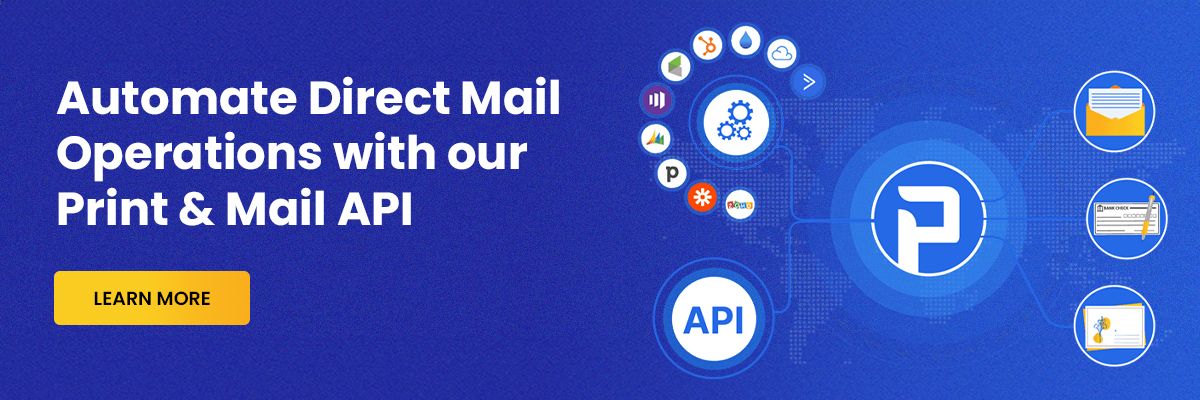
PostGrid is the perfect partner for crafting creative and impactful automotive direct mail campaigns. This is because PostGrid integrates seamlessly with 1600+ apps and allows businesses to produce thousands of unique, personalized marketing mailers. Additionally, dealerships and automotive businesses can easily align their physical and digital marketing efforts through webhooks and trigger-based mailings.
Here are some unique PostGrid features that empower the automotive industry to maximize sales and expand their operations:
- Seamless Integrations: PostGrid’s Print & Mail API integrates with all popular CRM, DMS, and marketing automation tools like HubSpot, Salesforce, Zapier, Shopify, and more.
- Dynamic Personalization: Leverage Variable Data Printing (VDP) to automatically customize every piece of mail to boost engagement and response rates.
- Premium Paper: For luxury dealerships, PostGrid allows for high-quality cardstock with a glossy finish that aligns beautifully with their brand needs.
- Trackable Attribution: Measure the impact of every mailer by embedding QR codes, PURLs, and custom discount coupons.
- Enhanced Deliverability: Validate and cleanse your mailing list with built-in CASS-certified address verification software before launching any campaign.
- Localized Print Network: PostGrid works with 35+ print partners across the U.S. and reroutes jobs programmatically to the printer closest to the recipient to reduce shipping costs and delivery time.
- End-to-End Tracking: You can easily follow every mail piece from production to final delivery to measure its effectiveness.
Sign up now to create high-volume, personalized automotive direct mail pieces to boost sales.