
Differences Between Flyer, Brochure, Pamphlet, and Booklet
Terminology note: The print industry does not use these terms in one fixed way. Printers, designers, and different regions may use “pamphlet,” “leaflet,” and “brochure” to mean the same thing.

This guide uses the most common meanings in North American print and direct mail work. Treat them as practical guidelines, not strict rules.
Brochure vs Flyer vs Pamphlet vs Booklet: The Difference
Marketers use several types of printed materials to promote their brands, communicate with customers, and educate their audiences. Yet few topics generate more confusion in print production than the terminology used to describe them. Ask five different print vendors whether a tri-fold sheet is a brochure or a pamphlet, and you will likely get five different answers.
The distinctions matter in practice. Selecting the wrong format wastes budget, dilutes your message, and can underperform in a direct mail campaign simply because the format does not match the communication objective.
A flyer sent as a standalone mailer to announce a sale is highly efficient. A flyer used to walk a prospect through a complex product portfolio is not.
This guide breaks down the four most common print marketing formats: flyers, brochures, pamphlets, and booklets. You will get clear definitions, a side-by-side comparison matrix, industry use cases, and a practical decision framework.
Side-by-Side Comparison of Each Format
The table below summarizes the core distinguishing characteristics of each format. Use it as a fast reference before diving into the full breakdowns below.
| Format | Bound/Folded | Typical Page Count | Primary Purpose | Common Use Cases | Distribution | Relative Cost |
| Flyer | Neither (flat sheet) | 1 page (1 or 2 sides) | Short, time-sensitive promotion | Event announcements, sales, new openings | Hand-to-hand, inserts, direct mail | $ (Lowest) |
| Brochure | Folded (2–6+ panels) | 1 sheet, multiple panels | Inform & sell product/service | Product overviews, trade shows, onboarding | Countertop, direct mail, hand-to-hand | $$ |
| Pamphlet | Unbound (may be folded or stapled) | 1–16 pages (typically 4–8) | Educate or inform on one topic | Health guidance, civic info, nonprofit education | Clinics, libraries, direct mail, events | $$ |
| Booklet | Bound (saddle-stitch, perfect, spiral) | 8–64+ pages | Detailed reference or catalog | Manuals, product catalogs, training guides | Mailed, distributed at events, account-based | $$$ (Highest) |
What Is a Flyer?
A flyer is a single printed sheet, typically unfolded and printed on one or both sides, used to communicate a brief, time-sensitive message to a broad audience at low cost.
- Some people refer to flyers as leaflets. They are usually one-sided and unfolded.
- Marketers use flyers in almost the same way as brochures. But the most crucial difference between flyers and brochures is the space.
- Brochures have ample room to print as much information as you want. You can simply add more panels to them if needed.
But you cannot do that with flyers as they are small in size and have no folds.
Key Features of Flyers:
- Often, flyers are printed on thinner paper stock to keep costs low.
- They are also known as circulars or handouts.
- Due to rough usage, flyers have a shorter life span than other printed items.
- They are used to communicate concise, short messages, like announcing a giveaway or a discount sale.
- Though flyers are traditionally printed only on one side, you can print them on both sides if you want.
- You can use A4 or 8.5” x 11” paper, but make sure they are short enough to handle easily.
- Flyers are distributed to people outside public places or during events.
Flyer Use Cases by Industry
- Healthcare: Appointment reminders, vaccination drive announcements, and clinic hours changes, where brevity and high-volume reach are more important than depth.
- Retail & Restaurants: Grand opening promotions, seasonal sales, and limited-time offers distributed as door drops or inserted with packaging.
- Nonprofits: Event fundraisers, community meetings, and awareness campaigns, where low production costs allow for wide saturation.
- Real Estate: Open house announcements and listing notices delivered to a tight geographic radius via Every Door Direct Mail (EDDM).
Flyers are an effective direct mail insert. Because they are lightweight and thin, they add minimal postage weight when included alongside a letter or statement, making them ideal for cross-promotional messaging without inflating mailing costs.
What Is a Brochure?
A brochure is a single sheet of paper, folded into two or more panels, printed on both sides, and designed primarily to promote a product, service, or organization through a combination of copy and imagery.
Brochures contain brief descriptions of a company’s products and services. They are printed in a wide range of sizes and on both sides.
The primary purpose of brochures is to sell by informing prospects about your brand’s offerings. There is a lot of room to add enough content with an offer and a closing CTA.
However, brochures consist of a lot of imagery, even more than words. Thus, you must keep your copy short, engaging, and to the point.
You can experiment with colors, designs, shapes, fonts, etc., to create the ideal layout for your brochures.
Another thing that makes brochures appealing is their folds. There are unlimited folding options that you can use, but some of the popular ones are:
- Bi-fold or half-fold
- Tri-fold
- Double parallel fold
- Right-angle bi-fold and tri-fold
- Z fold, etc.
Brochures are distinguished from flyers primarily by their fold structure and content capacity. Each panel of a brochure can serve a discrete communication function. A common tri-fold, for example, uses the cover panel for brand identity, the interior panels for product descriptions and benefits, and the back panel for contact information and a CTA. This narrative flow is impossible to replicate on a flat flyer sheet.
What Is the Difference Between Brochures and Booklets?
Brochures are frequently confused with booklets because both involve multiple panels of content. The clearest distinction is structural: brochures are a single folded sheet of paper, creating the appearance of pages without any binding.
Booklets are separately printed pages that are permanently bound together. A brochure cannot have more pages than its fold allows. In comparison, a booklet's page count is limited only by production economics.
Common Brochure Use Cases
- Financial services: Product rate cards, fund overview sheets, and wealth management service summaries, or formats where a prospect needs reference information they can take away from an advisor meeting.
- Healthcare: Patient-facing service guides, specialist referral materials, and insurance plan summaries where structured panels help segment complex information.
- B2B SaaS and technology: Solution briefs distributed at trade events and left-behind materials after sales calls, where the format signals professionalism without the cost overhead of a full booklet.
- Hospitality & real estate: Property features, floor plans, and community amenity guides, where high-quality paper stock and print production reinforce premium positioning.
Standard brochure sizes in the US
- 8.5″ × 11″ (letter tri-fold)
- 8.5″ × 14″ (legal tri-fold)
- 11″ × 17″ (tabloid bi-fold)
- 11″ × 25.5″ for larger multi-panel formats
Paper weight typically ranges from 80 lb. text to 100 lb. cover stock for premium finishes.
What Is a Pamphlet?
A pamphlet is an unbound publication focused on a single subject, typically used for educational, civic, or informational purposes rather than direct commercial promotion. It may consist of a single folded sheet or several loosely assembled pages.
Is a pamphlet the same as a brochure? Many people use the terms brochure and pamphlet interchangeably. But, in reality, they are very different from one another.
Pamphlets are small-sized, unbound booklets that provide information about a single subject. Please note that pamphlets are not used for selling or marketing. Their primary purpose is to inform or educate the readers. But that doesn’t mean you cannot use them as a subtle marketing tool.
Pamphlets offer a tremendous amount of flexibility to marketers regarding printing and folding options. You can either print separate pages and staple them together or use a single paper sheet and fold it. Also, you can customize the number of pages, size, and shape of your pamphlets.
Different Types of Pamphlets
- Cultural pamphlets: They provide details about different places and cultures, including their history, population, geography, demographic data, etc.
- Civic pamphlets: Civic pamphlets inform people about local affairs, like upcoming elections, referendums, ordinances, etc.
Educational pamphlets: Educational pamphlets tell or educate people on several topics, like medicine, training, science, technology, engineering, etc.
What Is the Difference Between Pamphlets and Brochures?
The clearest way to distinguish a pamphlet from a brochure is by asking: Is the primary goal to promote or to inform?
Brochures are fundamentally persuasive; they are designed to move a prospect toward a purchase decision or brand relationship. In contrast, pamphlets are fundamentally educational. They are designed to transfer knowledge or raise awareness on a specific topic, independent of a commercial transaction.
This intent difference has practical implications for design, distribution, and USPS classification. For example, a pharmaceutical company distributing safe medication guidance at a pharmacy is producing a pamphlet. The same company distributing a new product overview to physicians is producing a brochure. The physical format may be nearly identical; the purpose is not.
How Many Pages Are There in a Pamphlet?
Common print guides vary widely on pamphlet page counts. A working definition used by many North American print vendors and mail houses places pamphlets between 2 and 16 pages, with 4 and 8 pages being the most common production runs. UNESCO's statistical definition historically placed pamphlets at 5 to 48 pages. In practice, the format is flexible. What defines a pamphlet is its purpose and lack of permanent binding, not a rigid page count ceiling.
Industry Use Cases for Pamphlets
- Public health: Disease prevention guidance, vaccination schedules, and patient discharge instructions distributed at hospitals and clinics.
- Government & civic organizations: Voter information guides, emergency preparedness materials, and public program overviews.
- Insurance: Policy coverage summaries and member rights notices, materials that are legally required to be informational rather than promotional in nature.
- Nonprofits: Cause awareness, donor education, and volunteer onboarding materials where messaging integrity is prioritized over persuasion.
What Is a Booklet?
A booklet is a small, bound publication consisting of multiple printed pages. It is typically used for detailed reference material such as product catalogs, manuals, training guides, or comprehensive overviews that cannot be accommodated in a single folded sheet.
Unlike all the printed materials mentioned above, booklets aren’t used popularly. Yet, most people continue to refer to brochures and pamphlets as booklets.
But what is a booklet, and what is the difference between a booklet and a brochure?
Booklets are like brochures in a way, as they both have multiple pages. However, booklets have more pages than brochures and are bound together, not folded.
You may use wire-o, saddle-stitched, perfect, or spiral binding. The most commonly used option is saddle-stitched binding due to speedy turnaround time.
Booklets are durable and far more expensive than brochures, flyers, and pamphlets. Hence, it would be best to use them only for account-based marketing or while targeting hot leads.
Booklet Examples
- Workplace manuals
- Product catalogs
- Technical specifications, etc.
Binding Methods for Booklets
The choice of binding method affects both the perceived quality and the practical durability of a booklet. Understanding these options is important when specifying a print run for direct mail or account-based marketing:
- Saddle-stitch binding: Wire staples through the spine. Best for 8–64 page counts. Low cost, fast turnaround, lies relatively flat when opened.
- Perfect binding: Pages are glued at the spine with a flat cover, like a trade paperback. Best for 48+ pages. More premium appearance; suitable for product catalogs and annual reports.
- Wire-O / Spiral binding: Metal or plastic coil through punched holes. Lies completely flat when open. Preferred for manuals, training materials, and reference guides that are actively used at a desk or workstation.
When to Use a Booklet Instead of a Brochure
Booklets are the right choice when the communication objective requires depth that a folded brochure cannot accommodate. Specific decision indicators include:
- Product lines with more than five or six items require individual specification sheets
- Onboarding or compliance content that must be delivered in a legally complete format
- Account-based marketing to high-value prospects where the physical weight of the piece signals investment
- Catalog programs where recipients are expected to reference the material repeatedly over time.
The cost premium of booklets is real, as production and postage both increase with page count and binding method. Reserve booklets for use cases where that investment is justified by recipient value and expected shelf life.
Which Format Should You Use?
The fastest way to select the right print format is to match your communication objective to the format that is structurally designed for it. Use the guide below:
Use a Flyer if…
- Your message is short and time-sensitive
- You need a wide reach at a low cost
- You're announcing an event, sale, or opening
- The piece will be used once and discarded
- You're inserting into another mail piece
Use a Brochure if…
- You need to explain a product or service
- Imagery and design are central to your message
- The piece will be kept as a reference
- You need 3-8 panels of organized content
- Budget is moderate; print quality matters
Use a Pamphlet if…
- Your goal is education, not persuasion
- You're addressing a single, specific topic
- Content is civic, health, or policy-related
- Recipients need to trust the objectivity of the content
- You need flexibility in page count and format
Use a Booklet if…
- Content depth exceeds what a brochure can hold
- You're producing a catalog or manual
- The piece will be referenced multiple times
- You're targeting high-value accounts (ABM)
- Binding and page count signal production quality
💡Also Read: What Is a Trifold Brochure
How These Formats Fit Into Direct Mail Operations?
Understanding format differences is only one layer of the decision. For organizations sending print materials at volume, insurance carriers, financial institutions, healthcare networks, SaaS companies, or government agencies, the operational questions around address quality, production workflow, and delivery tracking matter just as much as format selection.
Format and Postage Class
Format directly affects postage cost and mail class eligibility. Flyers and single-panel inserts typically qualify as First-Class or Marketing Mail flats or letters, depending on dimensions and weight.
Booklets, depending on page count and binding, may need to be classified as flats or parcels, which carry different rate structures. Selecting the right format at the campaign planning stage, rather than after print production, avoids expensive reclassification at the mail house.
Address Verification Across All Formats
Whether you are mailing 500 flyers to a neighborhood or 50,000 brochures to a national prospect list, USPS address standardization and NCOA (National Change of Address) processing should be applied before the print file is finalized.
Undeliverable-as-addressed (UAA) mail is the highest controllable cost in most direct mail programs. It is entirely avoidable with proper address hygiene upstream of production.
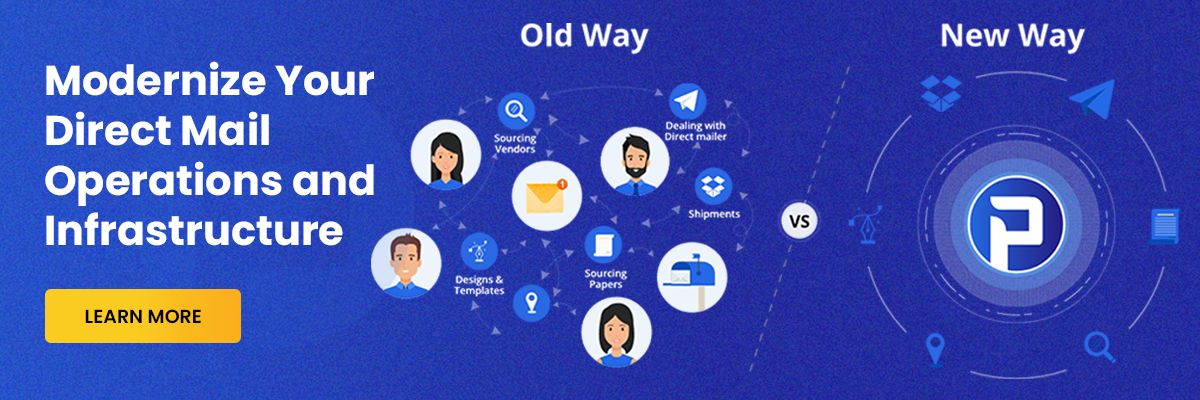
PostGrid's Print & Mail API handles the full operational layer of direct mail campaigns, address verification, template management, print production routing, and USPS-compliant mailing at scale. Whether you are sending brochures as part of a new customer onboarding flow or distributing booklets to high-value accounts, the platform automates the workflow from data to delivery.
Explore PostGrid’s Print & Mail API capabilities.
For teams managing recurring print programs, monthly statements, policy notices, and product updates, API-driven print and mail automation eliminates the manual coordination between design, production, and mailing, replacing it with a programmatic workflow that triggers print jobs directly from your CRM, EHR, or marketing platform.
How to Distribute Brochures and Pamphlets?
Now that you know the differences between a brochure, a pamphlet, and a flyer, you should also learn how to distribute them.
You can set down brochures and pamphlets on the checkout counter if you have an offline store. You can hand them the printed items at checkout or while talking to customers earlier.
Another way to distribute pamphlets and brochures is through direct mail, as it helps you reach out to your audience on a more personal level and increase response rates. For materials that require precise visuals, leveraging image editing tools can enhance the quality of your print designs by removing unwanted elements and creating a clean, professional look.
PostGrid’s print and mail API can help you send marketing and transactional items to intended recipients efficiently. You can design them using our pre-built templates and automate the entire process of print and mail.
Also, you can build new mailing lists and verify addresses in no time. Our direct mail services are affordable, fast, and effective to help you make the most of your campaigns.
You can sign up to learn more about our automated print and mail API that can revolutionize your offline mailing activities.
Frequently Asked Questions
Is a Pamphlet the Same as a Brochure?
No. The key difference is purpose: brochures are promotional materials designed to sell or market a product or service, while pamphlets are informational or educational materials focused on a single subject. The physical formats may look similar; both can be folded into single sheets. But the communication intent is fundamentally different. Brochures are outward-facing marketing tools; pamphlets are informational resources.
What Is the Difference Between a Booklet and a Brochure?
The core difference is binding and page capacity. A brochure is a single sheet of paper folded into multiple panels. It cannot have more pages than its fold structure allows. A booklet consists of multiple separately printed pages bound together (saddle-stitched, perfect-bound, or spiral-bound), allowing for 8 to 64 or more pages. Booklets are used for content that requires more depth than a brochure can accommodate: product catalogs, manuals, and training guides.
Is a Brochure Folded or Bound?
A brochure is folded, not bound. It is produced from a single sheet of paper that is folded into two or more panels (commonly tri-fold or bi-fold). The folded structure creates the appearance of multiple pages without any permanent binding. If a piece has separate pages that are stapled or glued at the spine, it is a booklet, not a brochure.
Can a Flyer be Double-Sided?
Yes. While flyers are traditionally single-sided, optimized for quick visual impact and low production cost, double-sided printing is entirely standard and commonly used. A double-sided flyer might use the front for the primary message or visual and the back for additional details, event logistics, or a map. Double-sided printing increases cost only marginally on most digital press runs and can meaningfully increase information density without changing the format's fundamental character.
Does the Terminology Differ by Region or Industry?
Yes, and this is worth acknowledging explicitly. In the United Kingdom, “leaflet” is the more common term for what North American markets call a flyer. “Pamphlet” has a more politicized historical connotation in some contexts (political tracts, advocacy documents) and is sometimes used as a general synonym for brochure in informal usage. Print vendors, designers, and marketers may use these terms differently. The definitions in this guide reflect the most widely accepted distinctions in North American print and direct mail practice.
Which Print Format Is Most Cost-Effective for Direct Mail Campaigns?
Flyers carry the lowest production cost per unit and the lowest postage weight, making them the most cost-efficient format for high-volume, time-sensitive campaigns. Brochures offer the best value when information density and design presentation are important, but budget constraints preclude a booklet. Booklets carry the highest production and postage cost and are best reserved for high-value account-based programs where the physical quality of the piece reinforces the message.
What Is the Difference Between a Flyer and a Leaflet?
In North American usage, flyer and leaflet are largely interchangeable terms for a single, unfolded printed sheet. In British English, “leaflet” is the standard term, while “flyer” can carry a slightly more event- or promotion-specific connotation. Some print vendors draw a size distinction, leaflets being A5 or smaller, flyers being A4 or letter-sized, but this is not a universally standardized difference. For practical purposes, the terms describe the same format: a single flat sheet used for short, direct-to-audience messaging.
💡Also Read: Angola Address Verification