


Best Postal Address Verification, Validation, Autocomplete & Geocode API and Platform
Verify, Validate, Geocode and Autocomplete Addresses across 245+ countries and territories globally with the Best & Most Accurate Address Data
TRY IT OUT
output Address result


Canada Address Format Mailing Guide
A Canadian postal address should have at least three lines to make it readable. Begin the address by mentioning the recipient’s full name in capital letters with an appropriate suffix (Mr., Mrs., Ms., Dr.) You can have an extra line to provide additional details about the recipient. Write the specific address with more information, such as the apartment number, unit number, or street number.
Also mention the municipality name, province, territory, and postal code. It is only necessary to include the country name if you are mailing to Canada from another country.

Postal authorities also recommend adding a return address to the mail pieces and parcels to improve the authenticity of the mail.
Following these guidelines helps you avoid delays and surcharges from additional processing.
FYI: Always stick to uppercase or block letters to improve the readability of your Canadian postal address.
In this article, we will explain the different types of Canada Post address formats and explain how to write Canadian addresses and send mail. This guide is provided by PostGrid and is based on publicly available information from Canada Post.
Keep reading!
TL;DR
- Canadian mailing addresses must have at least three lines for clarity and delivery.
- The format includes the recipient's name, civic address, municipality, province, and postal code.
- Including a return address enhances authenticity and ensures the mail can be returned if undeliverable.
- Proper use of uppercase letters and correct abbreviations is essential to avoid delays.
Key Takeaways
- Canadian mailing addresses are slightly different from US ones.
- Canada Post provides specific guidelines for the official Canadian address format.
- Canadian addresses must have at least three lines to make them readable and deliverable.
- A typical address includes the recipient’s name, additional recipient’s details, street address, province, and an appropriate postal code.
- It is a healthy practice to include a return address to the mailers and packages.
- The use of correct abbreviations and spacing is also necessary.
- Canada has different types of addresses, such as civic, postal box, rural route, general delivery, and military addresses.
Components of a Canada Address Format
Like US addresses, a Canadian postal address should have at least three lines to make them deliverable. If your address does not have three lines, you probably don’t have the complete details. Or there are chances that you are using the wrong format.
Mentioned below are a few components to include when writing Canadian mailing addresses:
Recipient’s Name
Write the recipient’s full name in capital letters on the first line. Use a suitable prefix, such as “Mr.,” “Ms.,” “Mrs.,” “Dr.,” etc., followed by the name. It is mandatory to mention the recipient’s name on the first line unless you are mailing a business. In this case, you can write the company name instead.
Moreover, it is better to write the concerned recipient’s name even while writing business addresses, so that you can direct the mail to the right person within a company.
For example, you want to mail a person named Mr. William, who is the HR head of XYZ company, which has 50 employees. If you skip writing his name on the first line, your mailpiece might reach the wrong recipient within the firm.
Hence, be upfront and write the recipient’s full and correct name to begin your address. Again, like US addresses, you can start writing in the middle of the envelope.
Additional Address Details
You can add an extra line to your mailing address if there is something that you wish to add. Sometimes, you may need to include the department name within an organization, like the sales and marketing department, the purchase department, etc.
Also, you can add the person’s designation as additional address details. All this information makes the delivery process more precise.
Take care to add these extra details on the second line, below the recipient’s name. Also, you should include this line only when it is needed or necessary.
Civic Address in the US, we mention the street address on the second line. It carries the apartment or unit number along with the street name.
Similarly, the Canada address format requires you to mention the civic address on the third line. If you don’t add any secondary address details, write the civic address on the second line.
Remember that there are several street types like alleys, avenues, parkways, drives, etc. They all have an abbreviation that you must use in your civic addresses.
Find below some examples:
| Street Types | Abbreviations |
| Boulevard | BLVD |
| Center | CTR |
| Range | RG |
| Orchard | ORCH |
| Expressway | EXPY |
| Road | RD |
| Street | ST |
| Passage | PASS |
| Highway | HWY |
| Point | PT |
| Avenue | AVE |
| Crossing | CROSS |
| Plateau | PLAT |
| Mountain | MTN |
| Line | LINE |
| Turnabout | TRNABT |
| Meadow | MEADOW |
| Grounds | GRNDS |
| Route | RT |
| Townline | TLINE |
| Harbor | HARBR |
*The above list is not exhaustive.
You should also mention the correct street directions, like N, S, E, W, NW, SE, SW, NE, etc. If you want to mention the apartment or suite number, you can use the following abbreviations:
- Apartment: APT
- Unit: UNIT
- Suite: SUITE
You can follow the following Canada street address formats:
- 101 JASPER AVE SW
- 25-108 CEDAR ST
- SUITE 5 BIRCHMOUNT RD
Municipality Name and Province or Territory
The following line should consist of the city or municipality name. However, a single city may have more than one municipality functioning in the area.
Canada has a total of 3,573 municipalities. So, be sure to write the correct name.
Leave a space after the city name and write the province or territory where your address belongs. Write their abbreviations instead of the name, exactly like US addresses.
Here’s the list of all provinces and territories in Canada with their 2-digit abbreviations as per Canada Post:
| Province or Territory Name | Abbreviation |
| Alberta | AB |
| New Brunswick | NB |
| British Columbia | BC |
| Nova Scotia | NS |
| Prince Edward Island | PE |
| Saskatchewan | SK |
| Manitoba | MB |
| Quebec | QC |
| Newfoundland and Labrador | NL |
| Yukon | YT |
| Nunavut | NU |
| Ontario | ON |
Postal Codes
Before we continue discussing how to format Canadian addresses, let us talk about Canadian postal codes. The mailing address format Canada needs you to write the postal code on the same line as the city and province.
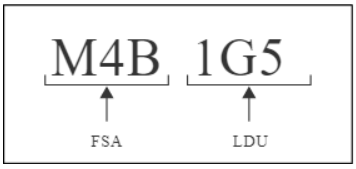
You need to leave two spaces after the province abbreviation before writing your postal codes. Unlike the ZIP codes in the US, postal codes are alphanumeric and have six digits. Postal codes follow the format ANA NAN, wherein A is an alphabet and N is a number.
They are divided into two broad segments: Forward Sortation Area (FSA) and Local Delivery Unit (LDU). The FSA defines a major geographical location, whereas the LDU identifies small delivery units.
Find below an example for better reference:
Every province and territory has a code letter that makes the first character of the FSAs. Here’s a list of these code letters as per Canada Post:
| Geographic Area | First Character of FSA |
| Newfoundland and Labrador | A |
| Nova Scotia | B |
| Prince Edward Island | C |
| New Brunswick | E |
| Eastern Quebec | G |
| Metropolitan Montreal | H |
| Western Quebec | J |
| Eastern Ontario | K |
| Central Ontario | L |
| Metropolitan Toronto | M |
| Southwestern Ontario | N |
| Northern Ontario | P |
| Manitoba | R |
| Saskatchewan | S |
| Alberta | T |
| British Columbia | V |
| Northwest Territories/Nunavut | X |
| Yukon | Y |
In the above example, M4B 1G5, it is clear that the mail is going to Metropolitan Toronto. Similarly, the other characters also help postal services deliver your mail to the exact destination.
So, the whole line should look something like this:
MONTRÉAL QC H1A 0B7
Country Name
If you send your mail from Canada to a Canadian address, you need not write the country name. But, you should always write the destination country’s name for international mailing.
While using the Canada mailing address format from the US, you should write the word “CANADA” on the last line.
It doesn’t matter how many lines you use in your USPS Canada address format, mention the country name at the end.
Here’s a Canada address example to help you understand better:
MR KEVIN DIAS
978 ARGYLE ST N
HALIFAX NS B3J 2B3
CANADA
If you don’t know the correct postal code or province, you can check the Canada Post website. But, you may or may not get the details you are looking for to write the correct mailing address.
Hence, PostGrid’s USPS and Canada Post address lookup helps you verify any address you want.
 Also Read: UK Mailing Address Format
What are the Address Formatting Recommendations for FedEx and UPS Canada?
Whether you are using FedEx or UPS, you must follow the format set by Canada Post to ensure your shipment is delivered without any delays. The guidelines may evolve; therefore, we recommend checking their official website or contacting customer care periodically for the latest requirements. It is also important to note that these shipping carriers check the addresses against the Canada Post requirements. Hence, any deviation might delay the processing.
Should I Include a Return Address While Mailing to a Canadian Address?
Many people ask the mail services questions like: Is writing a return address necessary? Should I write the sender’s address while mailing to Canada from the US?
The short answer is yes. Including a return address on your envelope or parcel is beneficial in many ways.
Firstly, it increases the authenticity of your mail. When a person gets a mail piece with the sender’s information printed on it, they are likely to trust the mailer. Also, if they want to reply to you via mail, the return address makes it easy to do so.
Apart from that, the return address assures that the mail is returned to you in case of non-delivery. It is especially crucial when you are mailing transactional and compliance documents.
If the item does not have the sender’s address, the postal service can discard it. Plus, your mail might end up in the wrong hands in some worst-case scenarios. Hence, it is advisable to write a return address on every mail piece you send.
Now, you might think about the Canada envelope address format for a return address. The good news is that you need to follow the USPS address format for your return address since you are mailing from the US.
Here’s an example of the US mailing address format:
MARILYN ARMSTRONG
60 10th AVE
NEBRASKA CITY, NE 68410
Place the return address on the top-left corner of your mailpiece. Make sure to differentiate between the return and mailing address correctly to avoid confusion later.
Also Read: How to Send Mail to Canada from USAHow to Validate Addresses to Send Mail to Canada or Other Countries
Once you know how to use the Canadian address format, you might ask how you can verify the address for error-free mailing. Luckily, you can use PostGrid’s International Address Verification solution to validate addresses of 245+ countries and territories. Thus, you can standardize, autocomplete, and verify mailing lists beyond the U.S. and Canada, ensuring you can contact your global audiences accurately.
Also, PostGrid can transliterate the delivery addresses to the destination country’s local scripts. It ensures that the country’s postal services can complete the premise-level delivery, down to the last mile. Here are some examples of the scripts we support:
- Kanji: Japan
- Cyrillic: Russia
- Arabic: United Arab Emirates
- Chinese: China
Our tool can transliterate addresses of any country from Latin to native languages. Thus, you can confidently mail across the globe without hassles.
Additionally, you don’t have to remember the global address formats of every country because we can handle it for you. For example, we can automatically standardize a Canadian address as per Canada Post’s guidelines. Similarly, we can break down and reformat any address according to the destination country’s preferred format. Hence, you can ensure low mail returns due to address misinterpretation.
💡Also Read: postage rates to Canada
Tips to Write Effective Letters
Here are some helpful tips businesses can use to write letters:
Add a Proper Introduction and Conclusion
The letter must have different and straightforward paragraphs. Add an introductory section in the beginning, discussing the letter’s motive. Make it short and precise.
The body should consist of all the details. Avoid adding the most crucial information in the first or second line.
You can add more paragraphs to provide more information, but keep the flow consistent.
Then, add a conclusion and closing to inform readers you want them to complete the CTA after reading the letter. Please don’t forget to include the valid contact details where people connect with you.
Be Consistent
Writing letters should be a natural process. Please don’t add unnecessary information or try to make it lengthy.
You should be consistent with your thoughts and ideas. Organize what you want to say in your letters and draft them accordingly.
Ensure your letter has an upfront message that readers can remember and act upon.
Address the Reader By Their First Name
It is always an excellent idea to address people by their first name. It makes them feel special and helps grab their attention.
Keep It Concise
Your reader might have a busy schedule and only get a little time to read your correspondence. Thus, keep it short and to the point. Express your primary objective in the first few sentences.
It lets people focus more on the details and know what to do next. Also, it shows that you respect their time and don’t want to spam them with unnecessary messages and information.
An excellent method is to use one-pager letters. It is short and helps people skim the message in only a few seconds.
The upcoming method is to use bullet points to divide different sections. It enhances your message’s readability and helps readers remember what you want to convey.
Proofread Your Letters
Cross-check whether your letters have spelling errors, typos, spacing, and other problems. You can ask your colleagues to proofread them and provide opinions on improving the messages.
Also, check the grammar to ensure a professional look. It helps your recipients think of your brand as reputable and authentic.
Establish Personal Connections
You can create personal bonds via business letters. Though formal, these messages are excellent for growing your network and expanding your brand.
Ask the reader about their whereabouts if you know them personally. Otherwise, you can talk using your brand’s perspective and create personal connections.
Avoid Complicated Language
Adding jargon or unusual words can make your letter unprofessional and messy. Hence, use everyday language that readers understand.
Also, help recipients understand what to do next.
Consider the Formatting
Formatting the letter the correct way can help make an excellent impression. Hence, please use one font throughout the message and keep the layout the same for all pages.
Also, please focus on the headings, primarily if you use bullet points or similar sections.
Send Letters Via Reliable Services
Sending letters via First-Class Mail allows you to ensure they reach the recipients on time. It is the most affordable and convenient way to send formal correspondence.
Also, Priority Mail is best for sending urgent messages, like contracts or checks with attached letters.
Also Read: How to Write a Letter to a PO BoxCollect Accurate Data with our powerful Address Verification API
Let us help you cleanse, correct, and standardize your database without disrupting your workflow.
REQUEST A DEMOAddressing Tips and Guidelines for Sending Mail to Canada
Now that you know how to address a letter to Canada, you should be aware of some other addressing guidelines.
Below are some tips that can help you address your items correctly:
- Write using uppercase or block letters.
- Avoid using the # sign. Instead, you can use a hyphen wherever needed, like between the apartment and street number.
- Use the correct abbreviations as discussed above. Never write the full name of provinces and territories because it can lead to delivery failures.
- Separate both parts of the postal codes with a space. In this case, refrain from using a hyphen.
- The standard address format Canada suggests leaving at least 0.6 mm or 15 inches of space on every side of the envelope.
- You can leave a maximum of 35 mm between the top of the envelope and the mailing address. Plus, take care to leave at least 10 mm on all the other sides of the label or envelope.
Find below the image of a standard envelope to help you understand better:
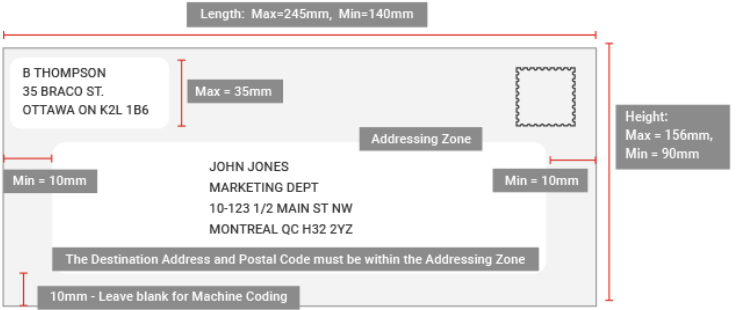
- On large envelopes, leave a minimum of 50 mm from the bottom of the envelope.
- If you want to insert your logo or other graphics on the face of your envelopes, place it toward the left of your mailing address.
- Try to print addresses rather than write them, as you can avoid any potential handwriting misinterpretation.
It is crucial to use the correct Canadian address format as the addresses are read by automated sorting equipment.
If the address does not fit the standard format, it can lead to several delivery issues.
Also Read: What Is A Non-standard Address?Common Mistakes in Canadian Address Formatting
Forgetting Space Between Segments
There should be a mandatory space between the third and fourth characters of the postal codes. A postal code, K1A 0B1, written as K1A0B1, will be misread by the automated systems.
Inaccurate Alphanumeric Order
The postal code is a combination of letters and numbers that appear alternately. Using an incorrect pattern might flag it as invalid.
Misordering Elements
The system shows an error if the city, province, and postal code are not in the correct place. For instance, you must place the postal code next to the city name, rather than on separate lines.
Missing Hyphens
The apartment or unit number should be on the same line as the street address. A hyphen should separate these two elements. Omitting the hyphen might confuse the automated system.
Side-by-Side Example of Comparison Between Incorrect and Correct Format
| Incorrect Format | Correct Format |
| 123 Main St. suite 678
John smith k1a 0b1, ottawa, on canada |
JOHN SMITH
123 MAIN STREET, SUITE 678 OTTAWA, ON K1A 0B1 CANADA |
How to Obtain the Canadian Postal Code Information
Senders that want to order a Postal Code Directory for Canadian mailings can write to this address to get the order form:
Attn: NATIONAL PHILATELIC CENTRE
CANADA POST CORPORATION
75 ST NINIAN ST SUITE 100
ANTIGONISH NS B2G 2R8
CANADA
You can also call on: 800–565–4362
Large-volume or frequent shippers that require Canadian postal code information or details about Canadian mailing standards must write to:
Attn: ADDRESS MANAGEMENT
CANADA POST CORPORATION
2701 RIVERSIDE DR SUITE NO813
OTTAWA ON K1A 0B1
CANADA
They can also call 800–260–7678
Is SERP Certification Crucial to Validate Canadian Addresses?
SERP stands for Software Evaluation and Recognition Program. It is a Canada Post certification for address validation and standardization vendors. If a platform or software is SERP-certified, they have access to the postal authoritative records. Also, they can access the NCOA data files to update the old addresses of people or companies that may have moved to a different address.
SERP is the gold standard for accuracy for Canadian mailing addresses. Thus, every address verification solution should get this certification to prove that it can match the quality and correctness. It is similar to USPS’s Coding Accuracy Support System (CASS) certification for U.S. vendors.
The top benefits of SERP certification include improved deliverability. If you regularly send mail using postal shipping services, you can ensure mailing accuracy and speed up delivery times. Also, it allows you to reduce mail returns significantly. The best part is that you can apply for Canada Post’s discounted postage prices if you presort mail and validate addresses beforehand.
If you want to validate your mailing lists under SERP, you can use PostGrid. We are CASS and SERP-certified, ensuring you always mail to the correct mailing addresses and pay low postage.
Readability of Your Canada Postal Address Format
USPS defines automation-readable items as mailers with accurate, valid, and correctly formatted addresses. It also considers whether the package or envelope has an Intelligent Mail barcode or ZIP+4 code.
Another crucial thing is whether it is readable on an OCR sorter or barcode. The Intelligent Mail barcode or IMB should reflect these ZIP+4 Codes, irrespective of whether senders pre-apply or print it using the OCR. It facilitates the highest sorting techniques for all mail items.
Here is an illustration:
Senders can type, write postal addresses, or use machine printing. Use dark ink on a lighter background, like white or sky blue.
Also, it is best to use uppercase letters to avoid confusion.
Please avoid using punctuation. You can add the hyphen in the address’s primary or secondary street number or within the ZIP+4 Code.
Format all address lines with a consistent left-sided margin. Add the country’s name in uppercase on the last line whenever you draft foreign addresses.
Address characters cannot touch each other, and senders must ensure equal spaces between them. All address lines must be parallel to the envelope’s bottom.
Please include all crucial details, like the apartment, suite, and floor numbers, with the directional codes.
Place an imaginary rectangle surrounding the entire address—the OCR read area. It extends from ⅝” to 2 ¾” from the item’s bottom with ½” margins on every mailpiece side.
The barcode clear area extends from ⅝” from the bottom. It goes up to 4 ¾” from the item’s right edge, where you can pre-apply an Intelligent Mail barcode (IMB) or print it using the OCR technology.
The irrelevant (non-address) printing you might notice in the OCR read area should appear above the delivery address line. It should be the farthest from the address block to avoid confusion or misinterpretation.
Also Read: Business Address ValidationDifferent Types of Canada Post Mailing Address Formats
There are several different types of Canadian addresses. Hence, there are also many different Canada Post standard address formats. Find them below:
Civic Addresses
The most common type of Canadian address is a civic address. You can add the recipient’s name on the first line and civic address on the second line.
Write the city, province, territory, and postal code on the third line. Then, mention “Canada” in the last line, and you are good to go.
If you need to mention any extra address details, you can write them below the recipient’s name.
Here’s an example of a Toronto, Canada address format:
RACHAEL LEFEBVRE
HR DEPARTMENT
87 DANFORTH AVE
TORONTO ON M4K 1M8
Civic Addresses in Rural Areas
Most rural areas in Canada also use civic addresses with rural postal codes. Find below an example:
ARIA BOUCHARD
4 FIRST AVE S
BIG VALLEY AB T0L 1K0
Formatting for PO Boxes
PO box addresses are a little different than civic addresses. Instead of writing the street address, you need to write the Post Office box number.
- Start your PO box address as usual with the recipient’s name.
- On the second line, write the postal box number and station information.
- The third line can be written in the same way as well, mention the municipality name, province or territory, and postal code.
Below is an example of the Canada Post PO box address format:
AUSTIN ADAMS
PO BOX 4600 STN B
COURTENAY BC V9N 0A7
However, you may add the civic address line as well. But, this line should always be above the PO box address line as the sorting equipment reads the addresses from the bottom up.
Formatting for Rural Route Addresses
You may ask how to format addresses in Canada with rural route identifiers.
Rural route addresses have the rural route identifier and the station information on the second line. The remaining lines can be written in the same way.
Find below an example:
HANNAH JOSEPH
RR 6 LCD MAIN
IQALUIT NU X0A 0A1
General Delivery Addresses
The full address format for Canada for general delivery addresses consists of:
- Recipient’s name
- The station information and general delivery identifier
- City, province, and postal code.
Below is an example for your reference:
AMY GILLIES
GD STN P
CALGARY AB T1X 1G4
Military Addresses
Below are all the components that you should include while writing military addresses:
- On the first line, write the rank, initials, and full name of the recipient.
- Then write the message or section number.
- Mention the name of the unit, operation, or ship on the third line.
- Write the PO box number along with “STN FORCES.”
- On the last line, write the city, province, territory, and postal code.
Here is an example:
MS MILEY BROWN
MESS #19
HMCS CALGARY
PO BOX 5048 STN FORCES
VICTORIA BC V8P3R2
If you want to write bilingual addresses, simply add a black vertical line separating the two of them. Other address placement guidelines should remain the same.
Bilingual Addressing in Canada Address Format
Dual Presentation Format
Add the address in parallel lines or columns in both languages. For example, you can first add the recipient's name, apartment number, and street address in English, followed by the same information in French. It will look like this.
| MR. JACOB SMITH/M. JACOB SMITH
13-23 KING STREET/13-23 RUE KING OTTAWA ON K1A 0B1 CANADA |
Language-Specific Elements
Prevent Redundancy
Industry-Specific Canadian Address Formatting
Banking
| ATTN: JACOB SMITH, ACCOUNT 1234567
123 MAIN STREET, SUITE 678 OTTAWA, ON K1A 0B1 CANADA |
Law Firms
| SMITH & ASSOCIATES LLP
ATTN: LEGAL DEPARTMENT, CLIENT CORRESPONDENCE 342 MAIN STREET, SUITE 789 OTTAWA, ON K1A 0B1 CANADA |
Insurance
| JACOB SMITH
POLICY #XYS1234 123 MAIN STREET, SUITE 678 OTTAWA, ON K1A 0B1 CANADA |
Credit Repair
| JACOB SMITH
DISPUTE DEPARTMENT FILE #2134 123 MAIN STREET, SUITE 678 OTTAWA, ON K1A 0B1 CANADA |
Government Organization
| MINISTRY OF HEALTH
ATTN: POLICY AND PLANNING DEPARTMENT 32 GOVERNMENT PLAZA, SUITE 342 OTTAWA, ON K1A 0B1 CANADA |
Also Read: How the Canada Postal Services Work?How to Send a Letter to Canada from the USA With the Correct Address Format?
Above, we discussed how to address an envelope going to Canada. But, you should also know about the different options that the USPS offers to send something to Canadian addresses.
You can use the following USPS services to mail to Canada:
- Global Express Guaranteed
- Priority Mail International Canada
- Priority Mail Express International
- Airmail M-Bags
- First-Class Mail International
- First-Class Package International
The postage for standard-sized postcards and letters begins at $1.30. You can use First-Class Mail International to send letters weighing up to 3.5 ounces.
If you mail to Canadian addresses frequently, you should consider buying Global Forever stamps. These stamps never expire, so you can send mail to international locations at any time without worrying about the changes in Canada’s postal rates.
Typically, deliveries to Canadian mailing addresses take about four to seven business days. But, it depends on which mailing class you select.
If you need to send something urgent, you can select Priority Mail Express International. But, it can take up to 20 business days for your mail to arrive if you choose options like First-Class Package International.
You need not go to the Post Office to send an envelope or parcel to Canada. The Canada Post website has an online customs form that you can fill out. Plus, you can buy packaging items and stamps online.
Avoid sending items that exceed the weight and size dimensions as prescribed by Canada Post to save on surcharges. Also, use the correct Canada address format international to avoid unnecessary trouble like lost or returned mail.
The best way to prevent such issues is to use PostGrid’s address verification API. It can help you verify your mailing addresses in advance so that you can mail confidently.
Furthermore, PostGrid also standardizes all addresses so that they are formatted properly.
Also Read: Postal Address ExampleDos and Don'ts of Writing Canadian Address Format
Do
Add All Address Elements
Include all the Important information, make sure to add the following details to the address:
- Recipient or company name
- Street address
- City/municipality
- Province/territory
- Postal code
- Country (on international mail)
Capitalize and Punctuate Consistently
Maintain a uniform style throughout the address. This consistency improves the legibility for the automated sorting system.
Verify Address Details
Check the format against the official postal standards of Canada Post to ensure accuracy. You can also refer to our Canadian Address Formatting Guide to learn how to structure the address correctly.
Provide Additional Detail Wherever Required
If you are sending the mail to a government organization or a business, make sure to include an attention line with the name of the department. If you are sending it to a multifamily building, be sure to write the apartment or suite number to prevent misdelivery.
Don’t
Use of Informal or Unapproved Abbreviations
Using non-standard abbreviations can confuse the automated sorting system or the postal workers. Wherever needed, use two-letter province and standard street abbreviations.
Mix Formatting Styles
Consistent formatting is necessary for manual postal workers and automated systems to process packages without any delays. Do not mix uppercase and lowercase letters haphazardly.
Add Unnecessary Punctuation
Don't add extra punctuation, symbols, or characters unless necessary, as they may confuse automated systems and cause errors.
Troubleshooting Canadian Address Formatting Errors
Diagnostic Approach
Once you have identified the problem, encourage the users to adopt a systematic approach to fix it. You can ask them to review the details against authoritative standards and manually cross-check them. You can also implement an address validation solution like PostGrid to check for common mistakes like missing spaces and improper abbreviations. To try our address validator, click here.
Implement Preventive Measures
If you rely on manual data entry, train your staff on the significance of standard formatting practices. You can also provide a clear guide that will act as a reference. Make it a habit to periodically review the address database to identify and correct errors before they cause delivery issues.
Features of PostGrid’s Address Verification API and Software
PostGrid’s address verification services can help you with your question: how do you write a Canadian address?
They allow you to write all domestic and international addresses in the proper format.
You can access our services through our address verification software or API. Either way, you can get access to fully-validated and standardized Canada address lists.
Below are some of our features that can help you mail accurately:
- International address validation: PostGrid can validate international mailing addresses of about 240 countries across the globe. Hence, you can get started with us irrespective of where you want to mail or which mailing lists you want to verify.
- SERP certified: Our API and software use Canada Post's authoritative database to ensure that all your Canadian addresses are formatted perfectly.
- Bulk verification: You can verify hundreds and thousands of mailing addresses altogether.
- NCOA: Millions of people move every year to Canada. Hence, PostGrid uses the National Change of Address (NCOA) data file to cross-check all the addresses.
- Fuzzy matching: Our address verification tools can identify and correct spelling, spacing, capitalization, typos, or other issues in your mailing lists. They can also add postal codes and missing details to your addresses.
Also Read: USPS Shipping to CanadaPostGrid for CASS Certified Address-Matching & Verification
We’re the direct mail & data- quality experts! And, we’re always ready to help you collect accurate mailing addresses.
SIGN UPConclusion
We hope that this blog can help you understand how to mail a letter to Canada. By following the correct formats, you can ensure that your items arrive on time. PostGrid can assist you in the process and make your work a lot more cost-effective, speedy, and efficient.
Want to verify your Canada mailing addresses in advance to save yourself from future hassles? Sign up now to get in touch!
FAQs
What is the Correct Format for a Canadian Mailing Address?
A proper Canadian address typically includes:
- Recipient’s name
- Street address (with unit/apartment if applicable)
- City, province/territory abbreviation, and postal code
- Country name (only for international mail)
Can I Send Mail From the U.S. to Canada Using USPS?
Yes. USPS handles Canadian and international mail deliveries. It helps transport your mail pieces up to the Canadian border. After customs clearance, Canada Post takes over and completes the last-mile deliveries within the country.
Do Canadian Addresses Require Uppercase Letters?
Yes. Canada Post recommends using uppercase or block letters to improve readability for automated sorting equipment and reduce delivery errors.
Where Should I Place the Postal Code in a Canadian Delivery Address?
The postal code must appear on the same line as the city and province, with two spaces between the province abbreviation and the postal code.
Should I Include “CANADA” When Mailing Within Canada?
No. The country name is only required for international mail. If you’re sending mail to Canada from another country (such as the U.S.), write CANADA on the last line in uppercase.